

In most English texting, JSP means “Just Playing” — the sender is telling you they were joking. In French chats, lowercase “jsp” almost always means “je sais pas” (“I don’t know”). In a coding or web-development conversation, JSP means JavaServer Pages. The language and tone around it tell you which one you’re looking at.
You open a message. Three letters stare back at you: JSP. Was that a joke? A shrug? Something to do with your friend’s coding bootcamp? You’re not overthinking it — JSP genuinely doesn’t have one fixed meaning, and even the sites that claim to define it can’t agree with each other. This guide walks through every real meaning of JSP, where each one comes from, and exactly how to tell them apart in the moment.
What Does JSP Mean in Text?
JSP is a three-letter shortcut that changes meaning depending on who’s typing it. In casual English texting, it most often stands for “Just Playing” — the sender’s way of saying a comment wasn’t serious. In French text messages, “jsp” is shorthand for “je sais pas,” meaning “I don’t know.” And if the conversation is about code or web servers, JSP almost certainly means JavaServer Pages, a Java-based technology for building web pages.
None of these is “the” official definition. Wiktionary’s entry for JSP defines it only as internet slang and text-messaging shorthand for “je ne sais pas,” meaning “I don’t know” — while English slang sites split between “Just Playing” and a handful of other expansions. That’s the one meaning with solid dictionary backing. The English “Just Playing” sense is real and common, but it lives in crowdsourced slang entries rather than a formal dictionary — which is exactly why context matters more than any single definition.
JSP Full Form in Text
Spelled out, JSP can expand to any of these, roughly in order of how often you’ll actually run into them:
| Full form | Language/field | How common |
| Je (ne) sais pas | French | Very common in French and bilingual chats |
| Just Playing | English slang | Common after a joke or tease |
| JavaServer Pages | Web development | Common in technical conversations |
| Just Saying (Peace / Period / Please) | English slang | Rare, and sites disagree on which version is “correct” |
That last row is worth pausing on. Some slang guides say JSP means “Just Saying, Period.” Others say “Just Saying, Peace.” A few list “Just Saying Please.” None of these has the kind of consistent documentation that “Just Playing” or the French meaning has — they show up on scattered slang-definition sites that don’t cite each other or agree on wording. If you see JSP used to soften an opinion rather than walk back a joke, one of these “just saying” variants is probably what’s meant, but treat the exact wording as fuzzy rather than fixed.
What Does JSP Mean in Slang?
As slang, JSP isn’t really a phrase — it’s a tone instruction. Its job is to tell the reader how to take the sentence that came before it, the same way a wink or a smirk would in person. Say something exaggerated, harsh, or dramatic, then drop JSP at the end, and you’re retroactively relabeling the whole line as a joke.
That’s a different function from what a word like “hilarious” or “kidding” does on its own. Those describe the message. JSP redirects it. It doesn’t explain the joke or add new information — it just flips a switch on how the previous sentence should land.
JSP Text Meaning in Online Conversations
Text strips out almost everything that carries tone in a face-to-face conversation: no raised eyebrow, no laugh, no pause before the punchline. JSP exists to patch that gap. It’s a small, typed stand-in for the parts of a joke that don’t survive translation into text.
That’s also why JSP causes more confusion online than the same joke would cause out loud. Read “You’re the worst roommate ever” on its own, and it can genuinely sting. Add JSP, and the sentence gets its missing context back. Online, where the message might be read by someone who doesn’t know your usual sense of humor, that little tag does real work.
JSP Abbreviation Explained
JSP’s roots trace most clearly to French SMS culture, where dropping vowels and shortening common phrases has long been standard practice. French texters routinely compress “pourquoi” to “pk” and “mort de rire” to “mdr” — and “je (ne) sais pas” shortens the same way, to “jsp.” Wikidata records JSP under both the English “JavaServer Pages” name and the French “Java server pages” naming, reflecting how the same three letters carry two separate linguistic histories.
The English “Just Playing” sense developed separately and later, inside general SMS and early chatroom culture, where any phrase that got typed often enough eventually got clipped down. There’s no single documented coining moment for it — like most texting slang, it just accumulated through repeated use until it stuck.
Why People Use JSP in Text Messages
Two different motivations sit behind JSP, and they don’t always overlap.
- Speed. Typing three letters beats typing out “I don’t know” or “I was just joking,” especially mid-conversation on a phone keyboard.
- Tone repair. Text can’t carry sarcasm or playfulness on its own. JSP retroactively signals that a line wasn’t meant literally, which matters more in writing than it would in speech.
The first reason applies to almost any abbreviation. The second is specific to JSP’s role as a joke-softener, and it’s the reason people keep using it even when a longer phrase wouldn’t cost them much extra typing time.
When Do People Use JSP in Texting?
JSP shows up most in these situations:
- Right after a teasing or exaggerated comment about a friend
- As a quick answer to a question you genuinely don’t have an answer to (mostly in French or bilingual chats)
- In a technical discussion about Java-based web development
- At the end of an opinion someone wants to state without sounding combative (the less-standardized “just saying” reading)
It’s rare in formal writing, client-facing messages, or anywhere the reader might not share the same slang vocabulary as the sender.
How People Use JSP in Daily Conversations
Almost nobody says “J-S-P” out loud. It’s a written-only shortcut — if someone wants to convey the same idea in speech, they say the actual phrase: “I don’t know,” “I’m just playing,” or, in French, “je sais pas” (pronounced roughly “zhuh say pah”). Spelling out three individual letters in conversation would sound stilted, so the abbreviation stays confined to typed messages, comments, and captions.
That’s worth knowing if you’re learning the term from text and wondering how to use it in speech: you don’t. Use the full phrase instead.
How JSP Is Used in Messaging
In practice, JSP mostly appears at the very end of a sentence, either attached to it or as its own short follow-up message. Capitalization doesn’t change the meaning — “JSP,” “jsp,” and “Jsp” are all read the same way, and most people default to lowercase because it’s faster to type. What actually carries information is placement: JSP tacked onto a statement functions as a modifier on that statement, while JSP sent alone, in reply to a question, usually functions as a complete answer (“I don’t know”) rather than a joke tag.
JSP Meaning Across WhatsApp, Instagram, TikTok & Snapchat
| Platform | Where you’ll see it | What to check first |
| Private one-on-one or group chats | The messages right before it | |
| DMs and comments | Whether the poster or commenter is writing in French | |
| TikTok | Comment sections | The language of the video and caption |
| Snapchat | Friend-to-friend chat | Whether it follows a joke or a question |
| Discord | Community and gaming chats | The server’s own slang habits |
| Thread replies | The subreddit’s topic and audience |
None of these platforms has invented its own private meaning for JSP — the differences come from who tends to use each platform and in what language, not from the app itself.
JSP on Social Media vs Text Messages
Private texts almost always give you more to work with: you know the sender, you’ve seen their sense of humor before, and you have the full thread above the message. Public comments on Instagram or TikTok strip a lot of that away. You might be reading a reply from a stranger with no prior context, which is exactly when JSP is hardest to read correctly. In that situation, lean on the language of the post itself and the tone of the comment thread around it rather than guessing from the abbreviation alone.
Examples of JSP in Real Chat Situations
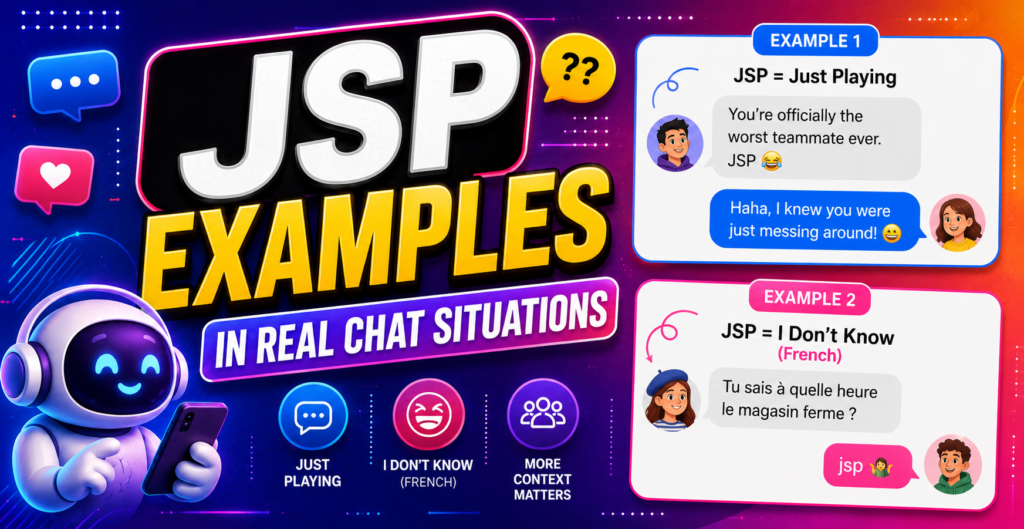
“You’re officially the worst teammate ever. JSP 😂” The laughing emoji plus the exaggerated claim makes this read as a tease, not an insult.
Friend: “Do you know when the store closes?” Reply: “jsp.” No emoji, no joke setup, just a direct question — this is “je sais pas,” not a joke tag.
“I’m blocking you. JSP 😭” Deliberately over-the-top statement followed by JSP — another joke, softened by the crying-laughing tone.
“We used JSP for the backend on that project.” No teasing, no question — a plain technical statement about JavaServer Pages.
Real Conversation Examples of JSP
| Message | Likely meaning | Why |
| “You’re so dramatic. JSP 😂” | Just Playing | Follows a tease, has a laughing emoji |
| “Who won the game? jsp.” | Je sais pas | Direct answer to a factual question |
| “Are you coming tonight? — jsp, I’ll let you know” | Je sais pas | Genuine uncertainty, no joke framing |
| “The homepage still renders through JSP.” | JavaServer Pages | Technical, no tone markers at all |
| “Pineapple on pizza is actually good, jsp” | Just Saying (unconfirmed wording) | Opinion stated casually, no joke or question involved |
JSP vs JK (Important Difference)
JK (“Just Kidding”) and JSP overlap in one use case — softening a joke — but they aren’t interchangeable. JK has one meaning that virtually every English texter recognizes instantly. JSP carries that same “just playing” sense for some people, but it also means “I don’t know” for French speakers and JavaServer Pages for developers, so it’s a much riskier abbreviation to send to someone who doesn’t already know your texting habits.
JSP vs JK Examples
“You’re paying for dinner tonight, JK.” Nobody misreads that.
Swap in JSP — “You’re paying for dinner tonight, JSP” — and a reader unfamiliar with the slang might genuinely pause. Is that a joke, or does JSP mean something else here? JK removes ambiguity. JSP, depending on the audience, can add it.
Is JSP Rude or Friendly?
On its own, JSP isn’t rude — its whole purpose in English slang is to soften a statement, not sharpen it. But it can’t fully undo the sting of something genuinely hurtful. “You’re absolutely useless, JSP” still lands as an insult with a weak apology stapled to the end; the abbreviation doesn’t erase the content of the sentence before it.
A useful rule: JSP works well for exaggerated, obviously-not-true statements (“I’m never speaking to you again, JSP”). It works poorly for statements that could be true and hurtful (“You never think about anyone but yourself, JSP”). The second kind needs an actual apology, not three letters.
How to Respond When Someone Says JSP
If the joke framing is obvious, you can just laugh it off or reply in kind — no need to overanalyze it. If it’s genuinely unclear which meaning is intended, ask directly rather than guessing: “Haha wait, what do you mean by JSP?” costs you nothing and prevents an awkward misread. If the message came right after a question you asked, and JSP is the entire reply, it’s very likely “I don’t know,” and you can just move the conversation forward.
What to Say If You Don’t Understand JSP
Keep it simple and low-stakes: “What does JSP mean here?” or “Wait, are you joking?” Both questions signal that you’re paying attention without making a bigger deal out of three letters than the situation calls for.
Different Meanings of JSP in Other Fields
Outside of texting, JSP has several established meanings that have nothing to do with slang:
- JavaServer Pages — a server-side Java technology for building dynamic web pages
- Jackson Structured Programming — a program-design method from the 1970s, described in Michael A. Jackson’s book Principles of Program Design, which analyzes the data structures a program reads and produces, then builds the program’s design around those structures
- Various organization and government abbreviations — AcronymFinder lists dozens of JSP expansions across business, military, and science categories, with 45 total meanings recorded across its slang and general listings
If someone sends you “JSP” outside a texting context — in an email signature, a job title, or a technical document — none of the slang meanings apply. Check the surrounding subject matter first.
JSP Meaning in Computer Science
In computer science, JSP (JavaServer Pages) is a technology that lets developers embed Java code inside HTML to generate web pages dynamically on the server before sending them to a browser. Released in 1999 by Sun Microsystems, JSP works similarly to PHP and ASP, but runs on the Java programming language, and needs a compatible servlet container such as Apache Tomcat or Jetty to run. The Eclipse Foundation, which now maintains the specification, describes it plainly as a technology that helps developers create dynamically generated web pages based on HTML, XML, or other document types.
One detail most slang articles miss entirely: the official name has changed. Since the technology moved under the Eclipse Foundation’s Jakarta EE umbrella, it’s formally called “Jakarta Server Pages” rather than “JavaServer Pages,” even though developers still call it JSP out of habit. It’s also increasingly considered a legacy choice — newer Java projects generally favor other frameworks, and JSP shows up more often in maintenance work on older enterprise systems than in new builds. None of that changes how the texting slang works, but it’s useful context if you hit “JSP” in a job posting or a code review and aren’t sure what era of Java you’re looking at.
Alternative Meanings of JSP
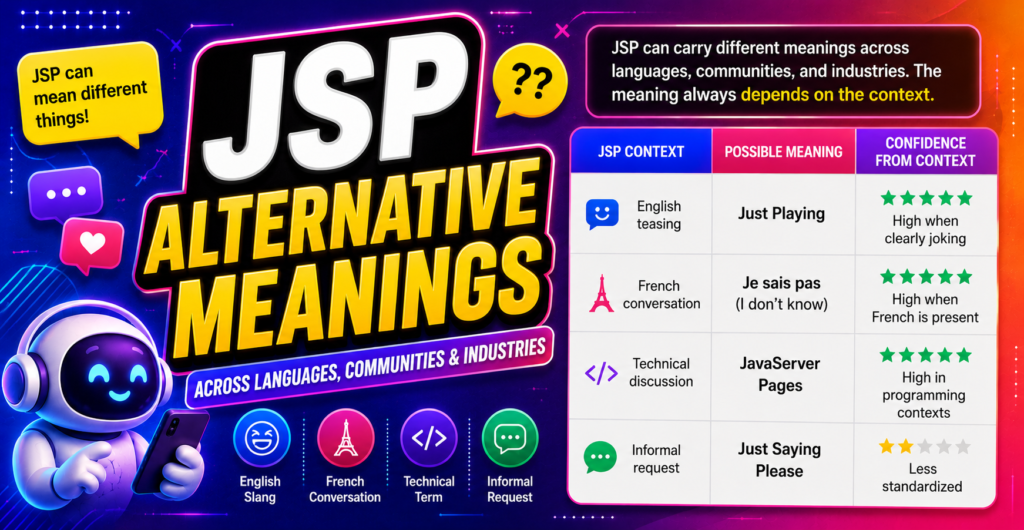
| Context | Meaning | How confident you can be |
| English teasing, with emoji | Just Playing | High |
| French text or bilingual chat | Je (ne) sais pas | High |
| Programming/web dev discussion | JavaServer Pages | High |
| Casual opinion, no joke or question nearby | “Just saying” (exact wording disputed) | Low |
| Job title, org chart, government document | Field-specific abbreviation | Depends entirely on context |
Common Confusions, Mistakes & Wrong Interpretations
The most common mistake is assuming JSP has one universal meaning and applying it everywhere. A second common mistake: reading every JSP as a joke tag, even when it’s actually answering a direct question — those two situations look nothing alike once you notice the pattern, but they get confused constantly by anyone treating JSP like a fixed vocabulary word instead of a context-dependent one. A third: assuming a JSP mentioned in a professional or technical setting must be slang, when it almost never is.
How to Identify the Correct JSP Meaning
Five checks, in order of how much they narrow things down.
Check the Words Around JSP
Read the sentence JSP is attached to. A teasing or exaggerated claim points to “Just Playing.” A direct question points to “je sais pas.” Neither, in a work or coding context, points to JavaServer Pages.
Consider Who Sent the Message
A friend who texts mostly in English is probably using the slang sense. Someone who mixes in French phrases, or who you know is a French speaker, is almost certainly using “je sais pas.” A developer colleague is talking about the technology.
Look at the Platform
Messaging apps and social DMs lean toward personal, casual meanings. Developer forums, GitHub issues, and technical Slack channels lean toward the programming meaning almost exclusively.
Read the Conversation Before and After
One message rarely tells the whole story. Scroll up. The exchange leading into the JSP message — a joke, a question, a technical thread — usually settles it without any guesswork.
Ask If the Meaning Still Isn’t Clear
If none of the above gets you there, just ask. It takes one message and saves you from replying based on a wrong guess.
Is JSP Still Popular? Trends & Online Usage
JSP hasn’t become obsolete, but it’s also never reached the near-universal recognition of LOL, IDK, or JK. It’s a second-tier abbreviation: widely understood inside specific friend groups and platforms, but not something every English texter will decode on sight. Some younger users have reportedly started favoring the even-shorter “JS” for “just saying” instead, which adds one more layer of ambiguity to an already-crowded abbreviation.
The French “jsp” meaning, by contrast, is stable and shows no sign of fading — it’s simply how French speakers type “I don’t know,” the same way English speakers type “idk.”
JSP Meaning in Different Generations
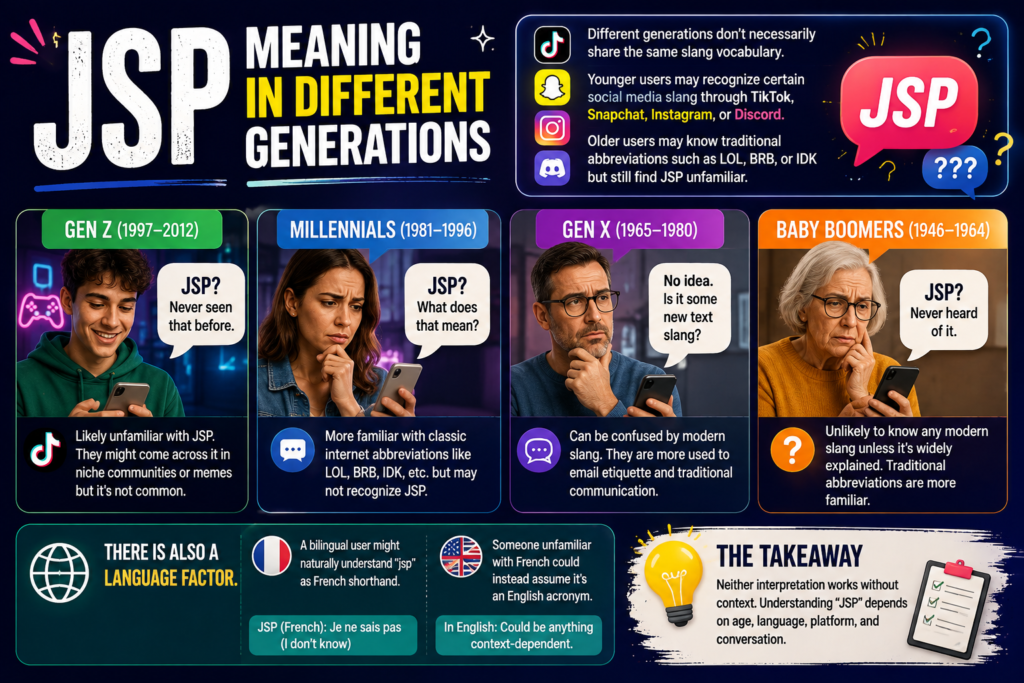
Recognition of JSP splits more by community than by strict age. Frequent texters, TikTok and Discord users, and people in bilingual or French-adjacent social circles run into it regularly. Older users or people outside those communities may know standard abbreviations like LOL and BRB but genuinely not recognize JSP at all — it hasn’t crossed over into mainstream, cross-generational slang the way some other abbreviations have.
JSP Meaning in Professional Communication
Skip JSP in client emails, formal reports, and any message where the reader might not share your texting shorthand — the ambiguity that makes it interesting in casual chat is a liability in professional writing. The one exception: among developers, “JSP” used in a technical document or code review almost always means JavaServer Pages, and using it that way is completely standard, not slang at all.
JSP Meaning in Gaming and Online Communities
Discord and other gaming chats move fast, and JSP shows up there in both its slang and its “I don’t know” forms — a player might type “Where’d he go? jsp” mid-match to tell teammates they lost track of an enemy, which reads as a quick admission of not knowing rather than a joke. Community-specific slang habits vary a lot from server to server, so a meaning that’s standard in one Discord community might be unfamiliar in another.
JSP Meaning With Emojis and Punctuation
Small formatting choices shift how JSP reads. “JSP 😂” reads as playful. “JSP?” reads as uncertain or checking for confirmation. “JSP…” with a trailing ellipsis can read as hesitant or even a little annoyed, depending on what came before it. None of these are hard rules — they’re leanings — but they’re often the fastest clue available when you don’t have much else to go on.
Conclusion
JSP doesn’t have a single correct answer, and that’s the whole point of understanding it properly. In casual English texting, it usually means “Just Playing.” In French or bilingual chats, it means “je sais pas.” In a coding conversation, it’s JavaServer Pages. Read the words around it, consider who sent it and where, and ask if you’re still unsure — that’s a faster and more reliable path to the right answer than memorizing a single definition ever will be.
FAQs
What Does the JSP Mean? In casual English texting, JSP usually means “Just Playing,” signaling a joke. In French chats it means “je sais pas” (“I don’t know”), and in tech contexts it means JavaServer Pages.
What Is JSP in Full? Most commonly “Just Playing” (English slang) or “je (ne) sais pas” (French). In programming, it stands for JavaServer Pages.
What Does JSP Mean From a Girl? The same as from anyone else — it depends on context. After a tease, it likely means “Just Playing”; as an answer to a question, it likely means “I don’t know.”
What Does JSP Mean Texting on Instagram? Usually “Just Playing” in English comments and DMs, or “je sais pas” if the poster or commenter is writing in French.
Is JSP Still Used? Yes, though it’s not as universally recognized as LOL, IDK, or JK — its French meaning is the most stable and widely used of the bunch.

Welcome to Special Blessing! I’m Umair, an AI-powered SEO and content writer with 5 years of experience. I create clear, helpful, and meaningful content designed to inspire readers, answer their questions, and make every visit to Special Blessing worthwhile.